The candy house
Hansel and GretelThe candy house is the children’s first apparent answer to hunger after they are lost in the forest, and then the setting of a new threat. Its edible architecture transforms food from a scarce necessity into an irresistible spectacle, but the Witch’s presence makes the house a trap: what the children can eat is part of a space controlled by someone who intends to eat them. The discovery thus turns wonder into danger before the house’s treasures help make possible the children’s return home.
Discovery After the Failed Trail
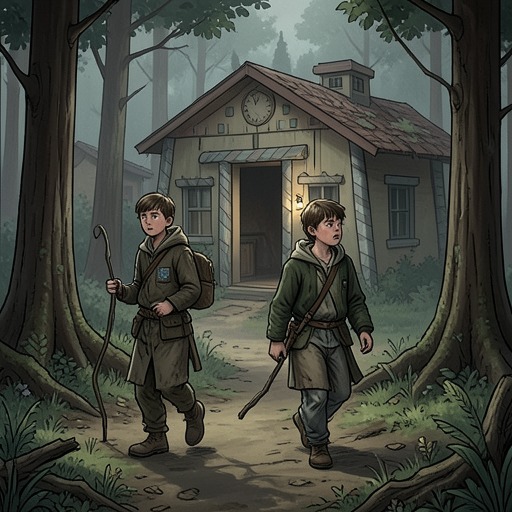
The house appears only after the children’s second abandonment. During the earlier journey into the forest, Hansel secretly scattered white pebbles, which led him and Gretel back home. When famine returned more severely, the Stepmother locked the door so he could not collect more. Hansel instead left Bread Crumbs along the way, but birds ate them. Lost in a thick, dark forest, hungry and frightened, the children wandered for hours before reaching a clearing and seeing the house. The timing makes the house more than a curious landmark: it is encountered at the point when the children’s own means of finding home have failed. After the pebbles’ dependable trail and the crumbs’ disappearance, the children face a forest they cannot navigate. The house answers their immediate need with food, but it does not restore their route or safety.
Edible Architecture and Temptation
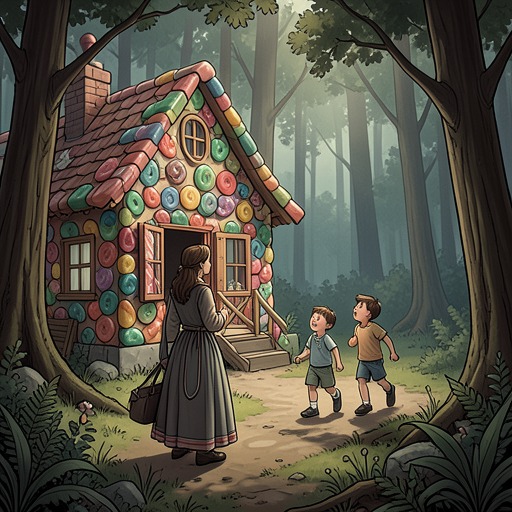
The house is made of sweets in nearly every visible part. Its roof is chocolate, its walls marzipan, its windows candy, its doors nougat, and its path confectionery. The description makes the whole approach seem edible, extending the children’s possible meal from a piece of bread to an entire building. Hansel runs toward the roof and proposes that he eat it while Gretel eats the windows; the children begin devouring the house without noticing the Witch quietly coming out to meet them. The contrast with the famine that has driven the plot gives this abundance its force. At home, hunger has prompted the adults to abandon the children; in the forest, food appears in extravagant quantities, built into a place that seems almost impossible. Yet the children’s relief is immediate rather than secure. Their attention to eating leaves them unaware of the person approaching, and the house’s inviting exterior conceals the danger associated with its owner.
From Shelter to Trap
The Witch addresses the children after they have begun eating her house, calls them in, and announces that she will eat them instead. She takes them prisoner. Her explanation of their intended roles makes the house’s threat concrete: Gretel is to help while Hansel is fattened, because he is too thin for the Witch to eat. She locks Hansel in a tiny room and keeps him there while waiting for him to grow plumper. The house’s food is therefore bound to control as well as appetite. The children have approached it as hungry visitors, but the Witch turns their trespass into captivity and treats Hansel as food to be prepared. Gretel, meanwhile, is assigned labor in the same plan. The house is not simply a place where the children find food; it is the center of the Witch’s power over them, where eating becomes a threat directed against the children themselves.
Defeat and Return
When the Witch grows tired of waiting for Hansel to gain weight, she lights a large oven and orders Gretel to climb inside to check whether it is hot. Gretel understands that the Witch means to trap and eat her too. Pretending she does not know how to enter, she persuades the Witch to demonstrate. Once the Witch is inside, Gretel shuts the heavy door; the Witch dies in the oven, and Gretel frees Hansel from his confinement. Afterward, the children find large bags of precious stones and pearls in the Witch’s house. They fill their pockets and leave the forest, eventually reaching the Woodcutter’s home. Their father rejoices at their return and tells them that the Stepmother has died. The children empty their pockets before him, and the jewels mean that he never again has to suffer want. The house’s final consequence is thus different from the promise that first drew the children to it: its sweets lead into peril, while the wealth found inside helps end the family’s material need.